
NSW Police Enforcement Laws
Understanding NSW Police Enforcement Laws: Your Rights, Police Powers, and What Every Resident Should Know
Chris David Alis
1/10/20266 min read
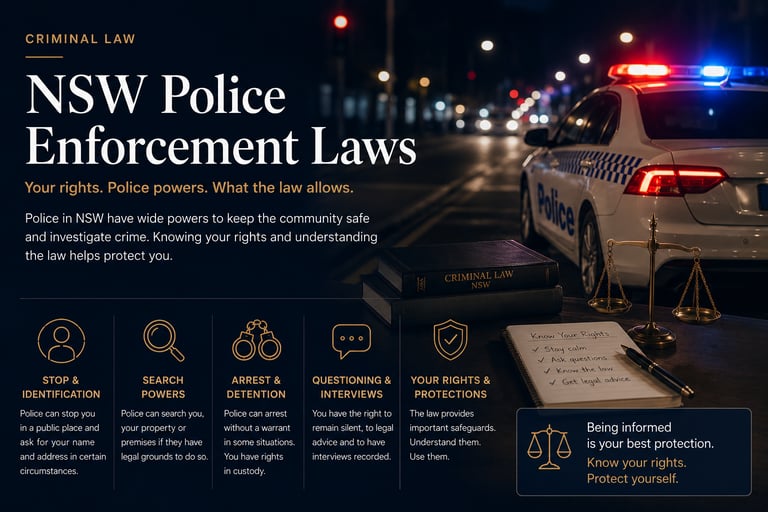
NSW Police Enforcement Laws: Your Rights, Police Powers & What You Should Know
Your Rights When Dealing With Police in NSW
Interactions with police can happen unexpectedly and often under stressful circumstances. Whether police stop you in public, ask to search your vehicle, request an interview, or attempt to access your phone, understanding your rights under NSW law is critical.
Police in New South Wales hold extensive powers under legislation such as the Law Enforcement (Powers and Responsibilities) Act 2002 (NSW) (LEPRA). However, those powers are not unlimited.
This guide explains:
Police search powers
Arrest rights
The right to silence
Phone and digital device searches
Drug dog and strip search laws
Vehicle searches
Police interviews
Move-on directions
Bail and detention rules
What to do if police act unlawfully
Quick Answers (60-Second Guide)
You generally have the right to remain silent.
Police usually need lawful grounds to search you.
You can ask: “Am I under arrest or free to leave?”
You have the right to speak with a lawyer before a formal interview.
Police interviews should generally be electronically recorded.
Police must usually identify themselves and explain the power they are using.
You do not generally have to provide phone passwords unless police have specific legal authority.
If arrested, police must provide important legal protections under LEPRA Part 9.
The Main Laws Governing Police Powers in NSW
Several major laws regulate police enforcement powers in NSW.
Law Enforcement (Powers and Responsibilities) Act 2002 (LEPRA)
The primary legislation governing police powers in NSW is the:
Law Enforcement (Powers and Responsibilities) Act 2002 (NSW) — commonly referred to as LEPRA.
LEPRA outlines:
Search powers
Arrest powers
Detention procedures
Move-on directions
Identification requirements
Warrants
Crime scene powers
Drug detection powers
Use of force provisions
Other important legislation includes:
Crimes Act 1900 (NSW)
Bail Act 2013 (NSW)
Road Transport Act 2013 (NSW)
Drug Misuse and Trafficking Act 1985 (NSW)
Surveillance Devices Act 2007 (NSW)
Terrorism (Police Powers) Act 2002 (NSW)
When Can NSW Police Stop You?
Police do not need a warrant to speak with you in public.
However, to lawfully stop, detain, search, or arrest someone, police generally require a lawful basis.
Police May Stop You If:
They reasonably suspect you are involved in an offence
They suspect you possess stolen property
They suspect you possess drugs or weapons
They are enforcing road transport laws
They are conducting lawful random testing
They are executing a warrant
You are entering or leaving a licensed venue or designated event area
In many situations, police must identify themselves and provide the reason for exercising their powers.
Police Search Powers in NSW
When Can Police Search You?
Police may conduct a search without a warrant if they reasonably suspect you possess:
Illegal drugs
Weapons
Stolen property
Items used in offences
Evidence connected to a crime
The key legal threshold is:
“Reasonable Suspicion”
This means police must have more than a vague feeling or intuition.
Courts have held that reasonable suspicion requires:
factual basis,
objective reasoning,
and identifiable circumstances.
Examples may include:
Visible drug paraphernalia
Witness information
Behaviour indicating concealment
Drug dog indications
Visible weapons
Drug Dog Searches in NSW
Drug detection dogs are commonly used at:
Train stations
Music festivals
Nightlife precincts
Public transport hubs
A drug dog indication alone may contribute to reasonable suspicion, although courts have criticised unreliable or unsupported indications in some cases.
Police may search:
Bags
Clothing
Vehicles
Personal belongings
However:
strip searches remain subject to stricter legal rules,
and must only occur when considered necessary and serious enough to justify the intrusion.
Strip Search Laws in NSW
Strip searches are among the most controversial police powers in NSW.
Police may only conduct a strip search if:
the circumstances are serious and urgent,
and the search is necessary.
Police must also:
provide privacy where possible,
minimise embarrassment,
avoid unnecessary touching,
and respect age and vulnerability protections.
Children and vulnerable persons have additional legal protections.
Courts and oversight bodies have repeatedly criticised unlawful or excessive strip searches.
Vehicle Search Powers
Police can stop and search vehicles if they reasonably suspect:
drugs are present,
weapons are present,
stolen property is inside,
or evidence connected to offences exists.
Police also have powers relating to:
random breath testing,
roadside drug testing,
registration enforcement,
defect inspections,
and dangerous driving investigations.
Drivers must generally comply with lawful directions relating to:
licences,
registration,
sobriety testing,
and identification.
Mobile Phone and Digital Device Searches
Digital privacy issues are increasingly important.
Police powers regarding phones and electronic devices depend heavily on:
whether you are under arrest,
whether police have a warrant,
whether consent is given,
and the type of investigation involved.
Important Distinction
Police cannot automatically search every phone simply because they ask.
In many situations:
police may require a warrant,
or another lawful power.
If police seek access to your device:
remain calm,
do not obstruct officers,
but seek legal advice immediately.
Arrest Powers in NSW
Police may arrest a person if:
they are committing an offence,
have committed an offence,
or police reasonably suspect involvement in an offence.
However, under NSW law:
Arrest Should Be A Last Resort
Police should consider alternatives where appropriate, including:
court attendance notices,
warnings,
summons,
or future attendance requirements.
An arrest may become unlawful if:
it was unnecessary,
excessive,
retaliatory,
or lacked legal basis.
What Are Your Rights During Arrest?
If arrested in NSW, you generally have the right to:
know why you are being arrested,
remain silent,
contact a lawyer,
contact a support person,
access medical assistance if needed,
and receive interpreter assistance where appropriate.
Police must generally caution individuals before formal questioning.
A common caution is:
“You do not have to say or do anything, but anything you say or do may be used in evidence.”
The Right to Silence
In most criminal matters, individuals maintain the right to silence.
This means:
you are generally not required to answer police questions,
beyond certain identification obligations.
However, there are exceptions.
For example:
drivers must provide licence details,
some terrorism-related investigations have different rules,
and refusing lawful directions in some circumstances may itself become an offence.
Because criminal law consequences can be serious, legal advice should be obtained as early as possible.
Police Interviews and Recorded Statements
Police interviews are commonly:
audio recorded,
video recorded,
or both.
Anything said during an interview may later be used in court.
Many people unintentionally damage their legal position by:
speaking emotionally,
guessing answers,
speculating,
or attempting to “explain everything” without legal advice.
Before participating in a formal interview:
request legal advice,
remain calm,
and understand your rights.
Use of Force by NSW Police
Police may use force when lawfully exercising powers.
However:
Force Must Be Reasonably Necessary
Excessive or disproportionate force may become unlawful.
Courts consider:
seriousness of the situation,
threat level,
resistance,
safety risks,
and proportionality.
Allegations involving:
assault,
excessive force,
wrongful arrest,
or unlawful detention,
can lead to:
complaints,
civil proceedings,
evidence challenges,
or disciplinary investigations.
Move-On Directions
Police may issue move-on directions in public places where they reasonably believe a person is:
obstructing others,
harassing people,
causing fear,
interfering with businesses,
or creating safety concerns.
Failure to comply with a lawful move-on direction can result in offences or further police action.
However, directions must still comply with legal requirements.
Bail in NSW
If charged, police may:
grant bail,
refuse bail,
or impose conditions.
If bail is refused by police, a court will generally determine whether bail should later be granted.
Courts consider:
seriousness of allegations,
criminal history,
community safety,
flight risk,
and likelihood of reoffending.
Bail conditions may include:
reporting requirements,
non-contact orders,
curfews,
residence conditions,
or travel restrictions.
Common Mistakes People Make During Police Interactions
1. Resisting Physically
Even if you believe police are acting unlawfully, physical resistance can significantly worsen the situation.
2. Providing False Information
Giving false details or misleading police may itself constitute an offence.
3. Speaking Without Legal Advice
Many people unintentionally incriminate themselves during informal conversations.
4. Consenting To Searches Without Understanding Rights
Consent can change the legal position substantially.
5. Posting About Investigations Online
Public social media commentary may later become evidence.
What If You Believe Police Acted Unlawfully?
Potential options may include:
making a complaint,
seeking legal advice,
challenging evidence in court,
or pursuing civil action.
Complaints can sometimes be made to:
NSW Police,
the Law Enforcement Conduct Commission (LECC),
or through legal representatives.
The appropriate legal strategy depends heavily on the specific circumstances.
Why Understanding Police Powers Matters
Police enforcement laws affect:
drivers,
students,
families,
professionals,
young people,
and ordinary members of the public every day.
Understanding your rights does not mean obstructing police.
It means:
recognising lawful boundaries,
understanding legal obligations,
and protecting yourself appropriately.
Common Practical Scripts
If Police Start Questioning You
“I do not wish to answer questions. I would like to speak to a lawyer.”
If You Are Unsure Whether You Are Detained
“Am I under arrest or am I free to leave?”
If Police Request Your Phone Password
“I do not consent to providing access to my device unless legally required.”
If Police Request Identification
“Can you please explain the legal basis requiring my identification?”
Final Thoughts
NSW police officers hold significant legal powers designed to protect public safety and investigate criminal activity. At the same time, those powers remain subject to legal safeguards and judicial oversight.
Understanding:
search powers,
arrest rights,
interview procedures,
and legal protections,
can help individuals navigate stressful police interactions more effectively and make informed decisions when legal issues arise.
If you are facing criminal allegations, police investigation, or uncertainty regarding your rights, obtaining timely legal advice is critical.
Disclaimer
This article is general legal information only and does not constitute legal advice. Laws may change and individual circumstances differ. Readers should obtain independent legal advice regarding their specific situation.
© 2026 CDA Legal & Associates. All rights


Open hours:
Available 24/7
ABN:
15253540142